


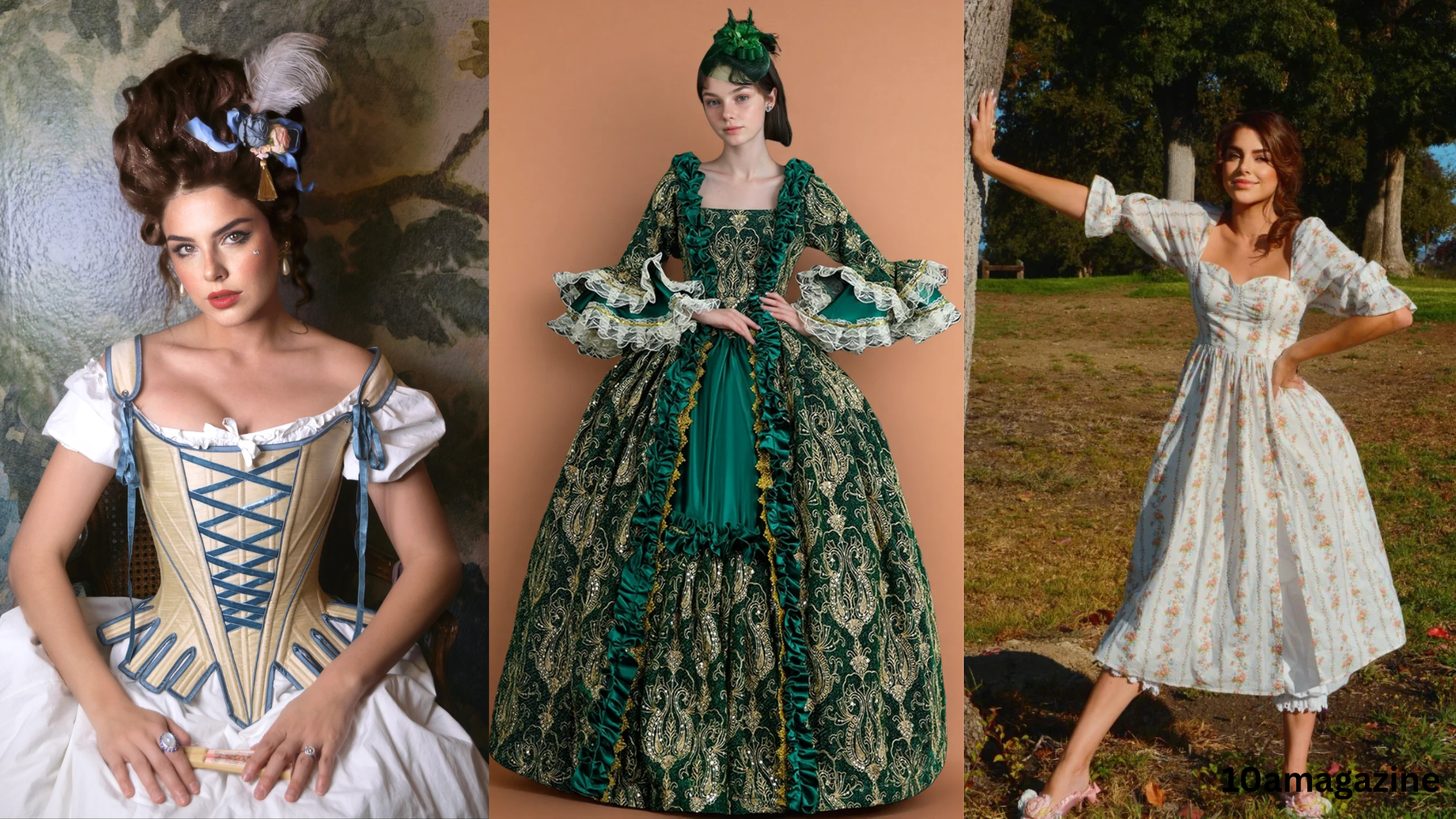
What Is Rococo Fashion?
Rococo fashion is one of the most visually rich and culturally loaded chapters in the entire history of clothing. It emerged in France in the early 1700s roughly from the 1720s through to the 1780s as a direct reaction against the heavy formality of the Baroque period that came before it.
Where Baroque fashion was stiff, dark, and designed to project authority, Rococo went the other direction entirely. Think pastel silks, cascading lace, oversized skirts, bows placed seemingly everywhere, and hairstyles that could double as architectural models. (Study.com)
The word “Rococo” itself likely derives from the French word rocaille, meaning shell or pebble referring to the curving, organic motifs that defined the era’s decorative arts. And that playful, asymmetrical, nature-inspired spirit carried directly into clothing.
The Historical Context: Why Did Rococo Fashion Happen?
Fashion never exists in a vacuum. Rococo style rose alongside a major cultural shift in France.
After the death of Louis XIV in 1715, the rigid, court-centered world of Versailles slowly gave way to a more relaxed aristocratic lifestyle. The French nobility retreated to private estates, hosted intimate social gatherings, and generally decided that life was for enjoying not just performing. (GANDIVA)
Fashion followed suit, quite literally. Clothes became looser, more personal, and more oriented toward pleasure and beauty than political display. This was the last great period where courtly fashion set the trend for all of Europe before the French Revolution changed everything. (GANDIVA)
It is also worth noting that Rococo fashion was no small regional quirk. French style dominated the courts of Europe during this period, and what Paris wore, London, Vienna, and St. Petersburg would eventually follow.
Key Characteristics of Rococo Fashion
Rococo clothing had a very distinct visual identity. Here are the defining features that made it immediately recognizable.
Pastel Color Palettes Forget the dark, heavy tones of the Baroque era. Rococo embraced soft pinks, powder blues, mint greens, lavender, and ivory. The palette felt light, airy, and deliberately feminine. (Fashion Law Journal)
Luxurious Fabrics Silk taffeta, satin, velvet, and delicate lace were the fabrics of choice. These materials were lightweight enough to drape elegantly but rich enough to signal serious wealth. Intricate floral embroidery and brocade patterns covered garments from top to bottom.
Ornate Decoration Rococo fashion was, to put it gently, not shy about embellishment. Fur trimmings, silk flowers, ribbons, ruffles, lace frills, and bows adorned every surface. If something could be decorated, it was. If it was already decorated, it could probably use a bit more. (Study.com)
Wide, Structured Skirts Women’s silhouettes featured dramatically wide skirts supported by panniers internal frames constructed from lightweight wood and linen. By the 1750s, pannier skirts could extend several feet to either side. They were designed to move with the wearer, folding when the wearer sat down. (Study.com)
Whimsical and Asymmetrical Design Unlike the rigid symmetry of Baroque design, Rococo embraced asymmetry and organic irregularity. Nature motifs flowers, vines, shells curved and twirled across garments in deliberately playful arrangements.
Iconic Rococo Garments You Should Know
The Robe à la Française This is the signature dress of the Rococo era. It featured a cinched front waist with a low-cut square neckline, while the back flowed freely in wide pleats from shoulder to hem. It was worn across Europe as both formal and informal dress throughout the mid-18th century. Dress historian Aileen Ribeiro described the 1740s specifically as “the triumph of the Rococo,” and the robe à la française was front and center. (Fashion History Timeline FIT New York)
The Robe Volante An earlier, even looser style that inspired the robe à la française. It offered women a remarkable amount of movement compared to the rigid clothing of previous decades. For aristocratic women accustomed to barely being able to sit down, this was genuinely liberating.
The Chemise à la Reine Introduced by Marie Antoinette in the 1780s, this was a soft white dress with a colorful sash and no corset. It was considered scandalous when it first appeared. Women wore it anyway. In fact, they loved it because it let them breathe, move, and feel like actual human beings. (History of Costume)
Men’s Justaucorps and Culottes Men’s Rococo fashion was no less elaborate. Men wore knee-length fitted coats called justaucorps, elaborately embroidered waistcoats, and knee-length breeches called culottes. Wigs were standard, white powdered, and taken very seriously. (Fiveable Rococo Costume)
The Women Who Defined Rococo Style
Madame de Pompadour If Rococo fashion had one architect, it was Madame de Pompadour — the official mistress of King Louis XV. She adored pastel colors, intricate patterns, and the light, decorative style that came to define the era. Her influence shifted fashion’s center of gravity from the formal court at Versailles to the cultural salons of Paris. She commissioned designs from leading artists and effectively made herself the taste-maker of her generation. (History of Costume)
Marie Antoinette Towards the end of the Rococo period, Marie Antoinette became France’s most prominent fashion figure, guided by her dressmaker Rose Bertin known as the “Minister of Fashion.” Marie Antoinette’s famous pouf hairstyle, a towering, elaborately constructed updo decorated with feathers, jewels, and sometimes miniature scenes, became a symbol of the era’s glorious excess. (Fiveable)
Rose Bertin As Marie Antoinette’s couturier, Rose Bertin pushed Rococo fashion to its most theatrical extremes. She is considered by many fashion historians to have established the foundations of what would later become haute couture.
Rococo Fashion vs. Baroque Fashion: What Is the Actual Difference?
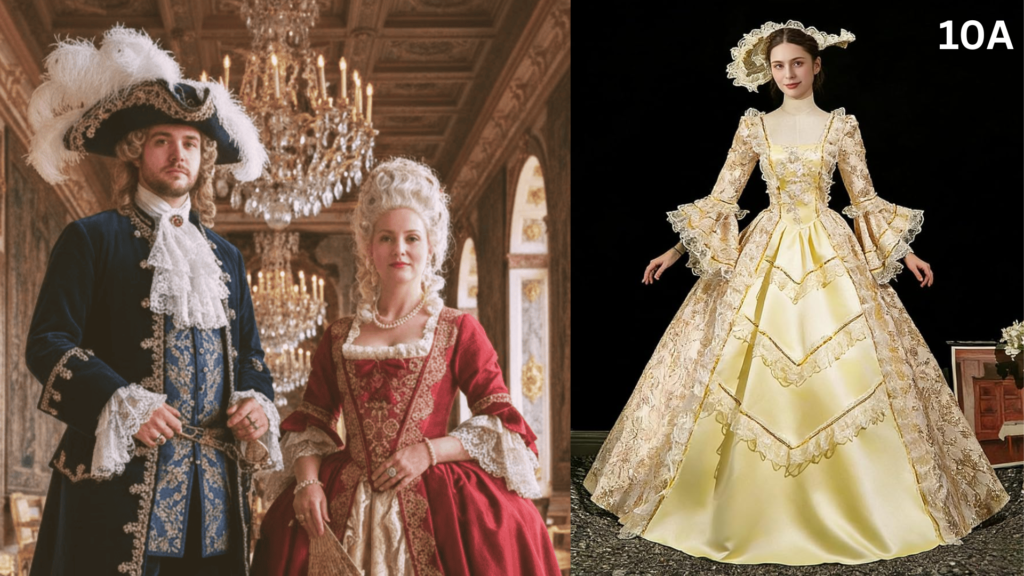
People often confuse these two periods, and that is understandable since one directly followed the other. Here is the straightforward distinction.
Baroque fashion (roughly 1600s to early 1700s) was heavy, dark, rigid, and designed to convey power and religious gravity. Deep jewel tones, stiff brocades, and structured silhouettes dominated. It was fashion as authority.
Rococo fashion (roughly 1720s to 1780s) rejected that seriousness. Colors went soft, silhouettes grew looser and more playful, and the mood shifted from gravitas to elegance and leisure. It was fashion as pleasure. (Fiveable)
Think of Baroque as a formal state dinner and Rococo as a garden party where everyone still showed up in their finest silk but smiled more.
The End of Rococo Fashion
Rococo fashion did not fade quietly. The French Revolution of 1789 brought a violent end to aristocratic culture, and clothing reflected the shift almost immediately.
The elaborate excess of panniers, powder wigs, and silk embroidery became politically dangerous symbols of the ruling class. Simpler, more democratic styles inspired partly by ancient Greece and Rome replaced them practically overnight. Neoclassicism swept into fashion as suddenly as the Revolution swept through France. (Study.com)
Rococo Fashion Today: Why It Is Everywhere Right Now
Here is where things get genuinely interesting.
Rococo fashion is experiencing a serious revival in contemporary style. Searches for “Rococo outfits” surged by +5,465% on Pinterest ahead of the 2025 season, according to data published by Marie Claire UK. That is not a typo. (Marie Claire UK)
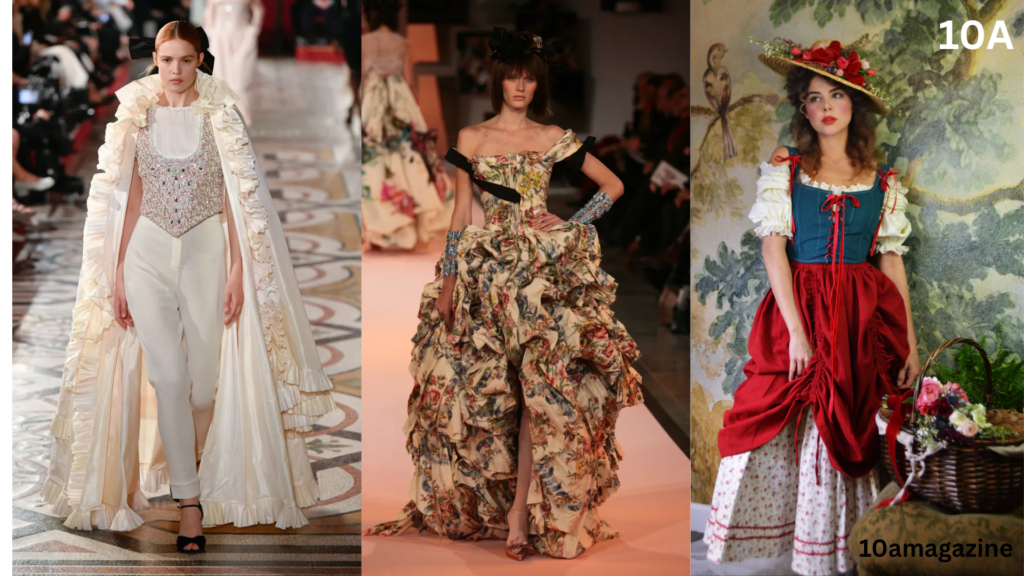
Designers across the industry are drawing directly from the Rococo playbook. Valentino and Dior have incorporated pastel palettes and corset-inspired silhouettes. Simone Rocha’s 2024 collaboration with Jean Paul Gaultier for his Spring 2024 Haute Couture show leaned heavily into Rococo ruffles and bows. Max Mara’s Spring/Summer 2026 collection cited Madame de Pompadour directly as its central inspiration. (Max Mara)
The Fall/Winter 2024 runway season marked what L’Officiel Monaco called a “Rococo renaissance,” with designers embracing delicate lace trims, ornate embroidery, and whimsical nature-inspired motifs across collections. (L’Officiel Monaco)
Even Harper’s Bazaar caught on their 2023 Women of the Year Awards was Rococo themed. (Crystal StyleIt)
The appeal makes sense. After years of minimalism and “quiet luxury,” people are ready for something that dares to take up space. Rococo fashion, with its ruffles and ribbons and unashamed love of decoration, is basically the antidote to beige.
How to Wear Rococo-Inspired Style Today
You do not need a pannier frame or a powdered wig to engage with Rococo fashion in 2025. The aesthetic translates naturally into wearable, modern pieces.
Here are some practical ways to incorporate the style:
- Lace-trim blouses or tops paired with contemporary trousers bring Rococo detailing without the full period costume effect.
- Pastel-toned midi or maxi dresses with structured bodices directly channel the silhouette without the extreme volume.
- Bow accessories on shoes, bags, or in the hair are one of the simplest Rococo nods available right now.
- Corset-inspired outerwear layered over simple pieces adds structure and historical reference in a very wearable way.
- Floral embroidery on jackets, coats, or dresses brings in the nature motif at a modern scale.
For those who want to go further, a puffed-sleeve dress in dusty rose or powder blue is the clearest Rococo statement a modern wardrobe can make.
Why Rococo Fashion Still Matters
Rococo fashion was never just about looking pretty though it did that extremely well. It reflected a society in transition, where art, pleasure, and personal expression became as culturally important as power and religion.
The fact that it keeps returning says something real about what people reach for when they want beauty that feels human, warm, and alive. Not severe. Not minimal. Not restrained.
Rococo fashion was, at its core, a celebration of the joy of dressing. And apparently, three centuries later, that still hits.