


The Raw Power of German Figurative Painting
There are artists who paint what they see. Then there are artists who paint what they feel — the mess, the beauty, the confusion, and the adrenaline of being alive. Florian Krewer is firmly in the second group.
Born in 1986 in Gerolstein, a small town in western Germany, Krewer has built one of the most talked-about careers in contemporary figurative painting. His large-scale oil canvases pulse with youth, desire, urban tension, and a kind of beautiful chaos that pulls you in before you even figure out what you are looking at.
From House Painter to Fine Artist — The Origin Story
Here is a fun fact that puts Krewer’s journey into perspective: before he ever set foot in an art school, he spent three years working as a literal house painter. That is not a metaphor. From 2003 to 2006, he was up ladders and rolling walls for a living.
He left school at 16, describing himself as a “distracted” student. He tried various paths — construction draughtsmanship, survey work — before landing the house painting apprenticeship. Eventually, he enrolled at the Cologne University of Applied Sciences to study architecture in 2008. It was there that something shifted.
During an architecture project that required him to actually pick up a brush, he discovered his instinct for paint — its fluidity, its spontaneity. Architecture felt too rigid. Paint felt alive. (Source: Ocula)
By 2011, Krewer had enrolled at the prestigious Kunstakademie Düsseldorf, one of Germany’s most respected art academies — the same institution that shaped Gerhard Richter and Sigmar Polke. He studied under Scottish painter Peter Doig, who he later described as a “father figure.” He graduated in 2017 and picked up the Beatrice R. Potter Prize for accomplishment in painting on his way out the door. Not a bad exit. (Source: Michael Werner Gallery)
The Art Itself — What Makes Florian Krewer Different
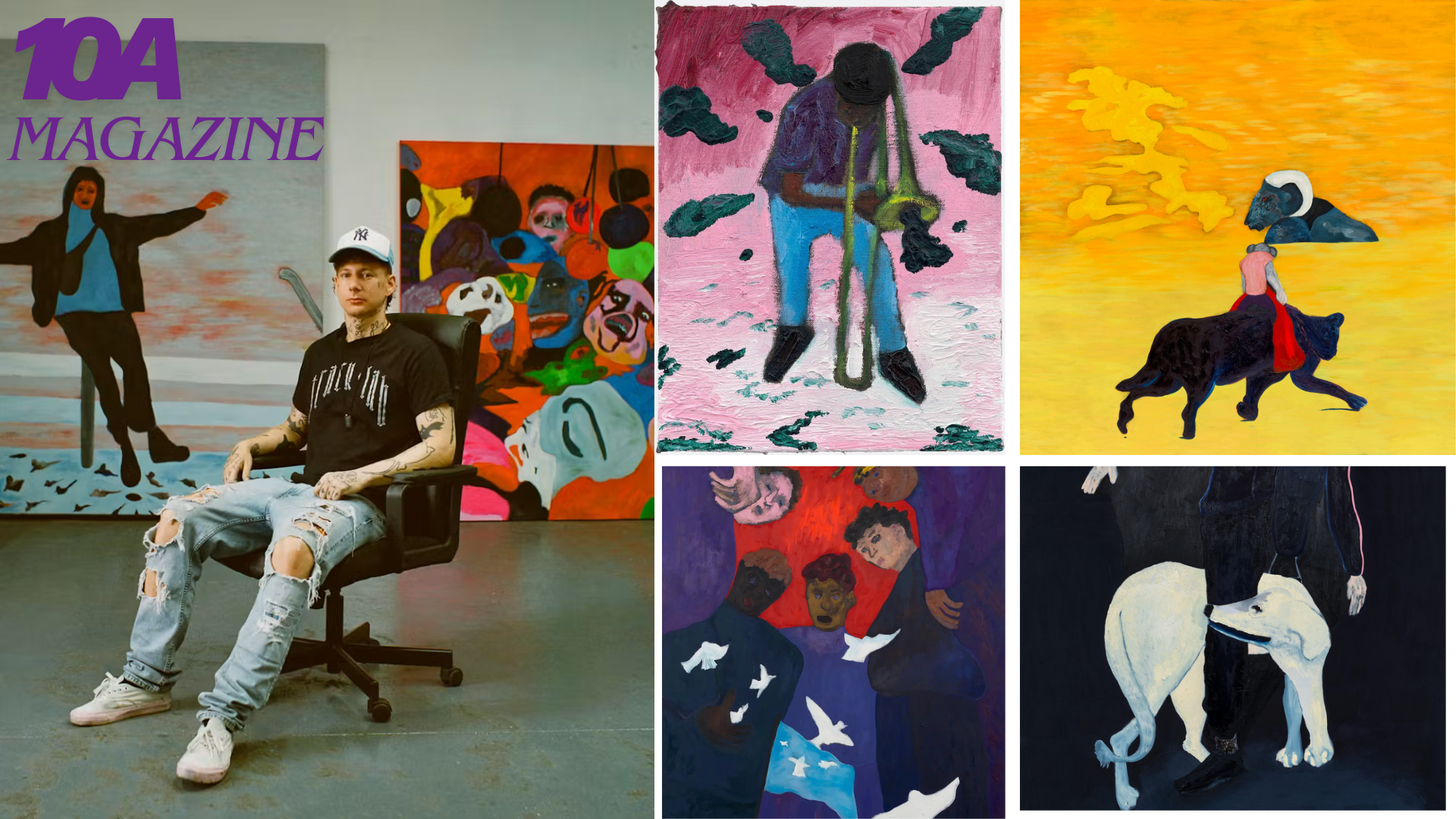
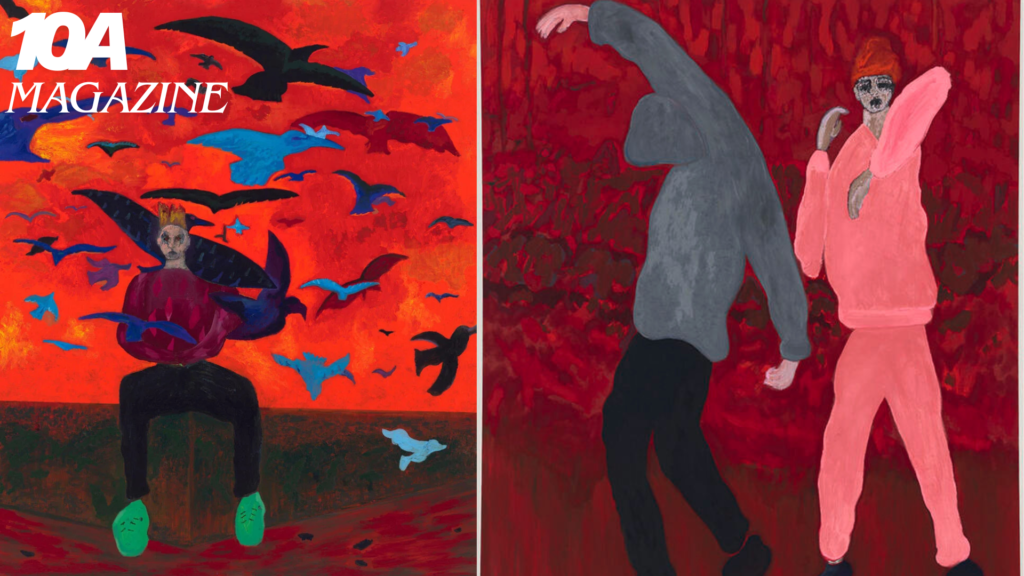
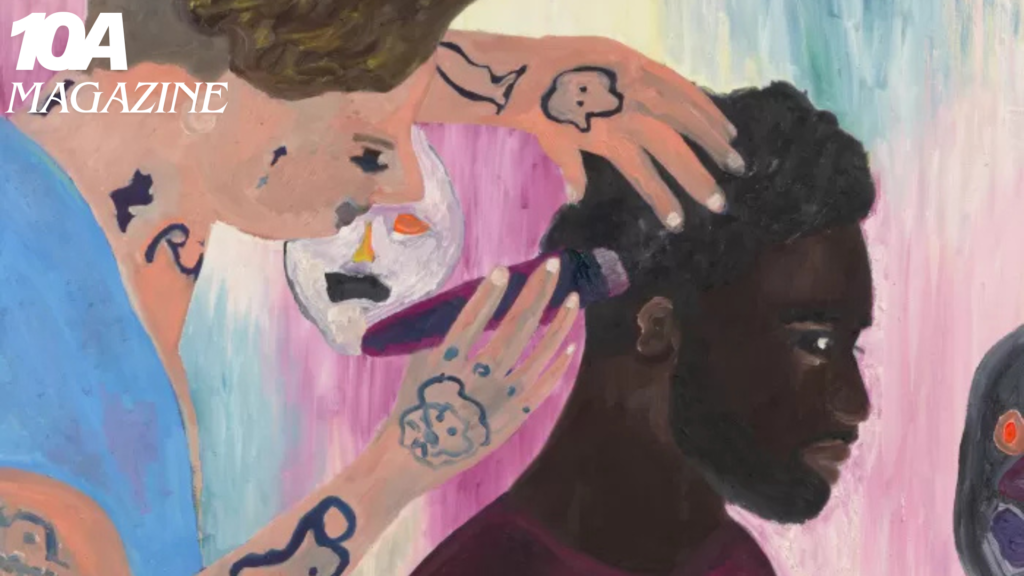
Walk into a Florian Krewer exhibition and you notice something unusual immediately: the faces are missing. Or rather, they are there — but smeared, obscured, hidden beneath hoodies, masks, or thick applications of paint that dissolve features into abstraction.
This is entirely intentional.
Krewer’s paintings begin in either found or personal photographs he has taken. These photographs may be cut, collaged, and eventually redrawn to become the studies from which his paintings in oil emerge. Photographic specifics of time and place are mostly absent, save for a few occasional details — a horizon line, or an arrangement of colored planes suggesting perspective — to frame the action.
The result is a strange intimacy. You feel you are watching real people in real moments, but you can never quite pin down who, where, or what exactly is happening. That ambiguity is the point.
His large-scale canvases of streetwear-clad youths, ambiguous nudes, and the occasional wild animal draw inspiration from the artist’s personal life, seen through the lens of his own imagination.
His palette deserves its own mention. With a colour palette presenting a surprising range of night-dark blacks, unclean whites and artificially-sweetened pinks, purples and blues, Krewer’s paintings explore conflicts and desires consumed in the public spaces of cities.
Think neon signs bleeding into wet pavement. Think the way a nightclub looks at 2am when everyone has forgotten to behave themselves. That is the visual energy of a Florian Krewer canvas.
Life in the South Bronx — New York Changes Everything
In 2020, just one month before the COVID-19 lockdown, Krewer relocated from Germany to the South Bronx. The move was clearly transformative.
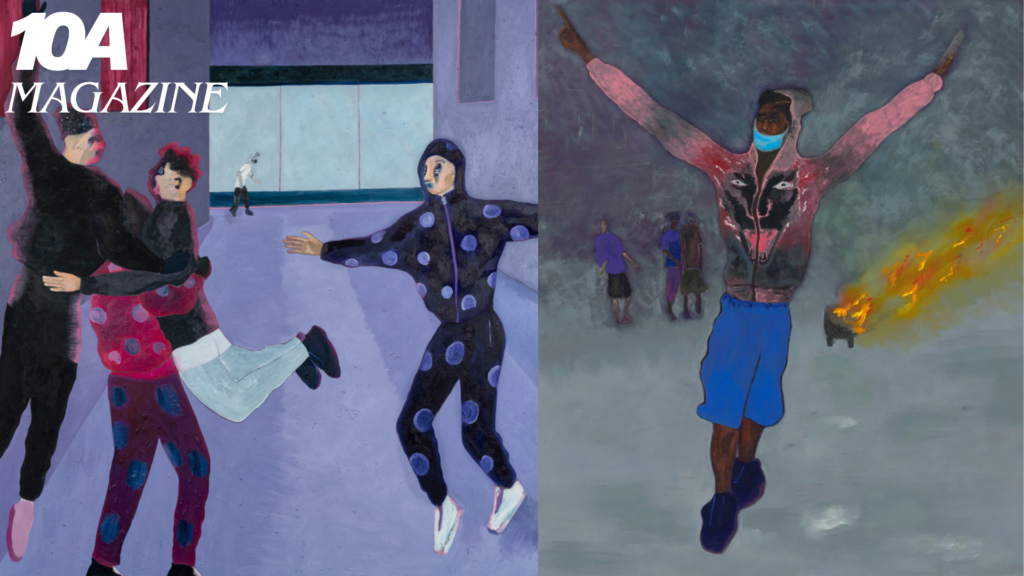
Moving to New York — particularly to an area as raw and community-driven as the South Bronx — gave Krewer’s work a new charge. The energy of the city, the street culture, the political heat of the Black Lives Matter movement — all of it made its way onto his canvases.
His studio in Hunts Point, six flights up with a view of the whole city through a “smudged picture hole,” became the creative engine for some of his most powerful work. (Source: Cultured Magazine)
Major Exhibitions — A Career That Keeps Accelerating
Krewer’s exhibition record reads like someone in a serious hurry:
Solo Shows (Selected):
- 2025 — cold tears released, Michael Werner Gallery, New York
- 2024 — Cruel The Night Café, The Perimeter, London
- 2024 — strike the dust, Michael Werner Gallery, Beverly Hills
- 2023 — Nice Dog, M WOODS Museum, Beijing
- 2023 — everybody rise, Aspen Art Museum (his first major US institutional solo show)
- 2023 — light the ocean, Michael Werner Gallery, New York
- 2021 — ride or fly, Michael Werner Gallery, London
- 2020 — Eyes on Fire, Michael Werner Gallery & TRAMPS, New York
Full of rampant desires and fervent dreams, Krewer chronicles his recent travels, experiences, and revelries on the canvas. He celebrates community and love, while at the same time documenting his profound feelings of injustice, isolation, loneliness, and loss.
His work also entered the Pinault Collection — one of the most significant private contemporary art collections in the world — a seal of institutional credibility that serious collectors pay attention to. (Source: Ocula)
In 2022, he received the Prix Jean-François Prat, awarded by the Bredin Prat Foundation in France, further cementing his place in the European contemporary art conversation. (Source: Prix Jean-François Prat)
The Loewe Moment — When Fashion Came Calling
It is not every day that a luxury fashion house puts a painter at the center of its runway collection. But in 2021–2022, that is exactly what happened with Florian Krewer.
Loewe’s latest take on its show-in-a-box concept, for its S/S 2022 menswear and Resort 2022 collection, included a monograph of paintings by Krewer that immerse us in the dynamic energy of urban life.
Creative director Jonathan Anderson — the same person responsible for turning Loewe into one of the most culturally relevant luxury brands on the planet — chose Krewer’s paintings as the thematic anchor for the season. The key inspiration were the funky, naïve paintings of sexual liberation by the German artist.
The collaboration also included legendary photographer David Sims. Fashion and fine art colliding in a way that made both feel more interesting. That is a difficult trick to pull off, and Krewer managed it without his paintings feeling like accessories. (Source: Wallpaper*)
What Florian Krewer’s Work Is Really About
Peel back the visual style and Krewer’s work is dealing with big, human questions: identity, desire, community, vulnerability, and what it means to inhabit a body in a complicated world.
Florian Krewer explores the lives of young people and the various impulses that drive them, facing the tough world they are living in: love, pure energy (dance, sport, etc.) and aggressive attitudes. The urban characters in Krewer’s paintings seem to escape from these situations by a kind of levitating gesture and a dynamic placement of the figures on the canvas where, sometimes, animals suggest an analogy between humans and their primary condition.
He draws on personal experience without making the work self-indulgent. As he put it himself: “Painting is my medium. It’s my language of expression. I don’t think about anything else.” (Source: Flaunt Magazine)
There is also something surprisingly tender in his approach to subjects society often ignores. As writer Stanton Taylor observed in a 2021 catalogue: the figures populating Krewer’s paintings are the very kind of people that the kind of people who like looking at paintings like to avoid That tension — between who gets represented in high art and who does not — gives his work a political edge without ever becoming a lecture.
Where to See and Follow His Work
If you want to explore Florian Krewer’s paintings further, these are the most reliable and up-to-date sources:
- Michael Werner Gallery (his primary gallery): michaelwerner.com
- Artsy (biography, auction results, available works): artsy.net
- Artnet (market data and exhibition history): artnet.com
- Ocula (critical writing and collector context): ocula.com
- Aspen Art Museum (documentation of his first US institutional show): aspenartmuseum.org
- Frieze (critical reviews): frieze.com
Final Thought — Why Florian Krewer Matters Right Now
Contemporary painting has a lot of people doing a lot of things. Some of it is clever. Some of it is beautiful. Very little of it actually makes you feel something in your chest.
Florian Krewer’s work does that. It captures the texture of life in cities — the danger, the tenderness, the hunger, the confusion — with an urgency that does not feel performed. He came from outside the art world, trained himself honestly, moved to one of the world’s most intense cities, and made paintings that refuse to be comfortable.